

When it was evening on that day, the first day of the week, and the doors of the house where the disciples had met were locked for fear of the authorities, Jesus came and stood among them and said, “Peace be with you.” After he said this, he showed them his hands and his side. Then the disciples rejoiced when they saw the Lord.
John 20:19-20
Happy Easter!*
I hope your celebration was joyful and unhampered by bad weather. In Nebraska, it’s not unusual to hold Easter egg hunts in the snow, especially when the holiday comes so early. We were able to spend Easter in Florida this year and it was a particularly beautiful day.
Florida has an abundance of many things – like sunshine and sand – but in particular it has an abundance of shells. There are shells everywhere, even mixed into the pavement. Like many people I am always looking for interesting specimens, but finding shells that are undamaged can be challenging.
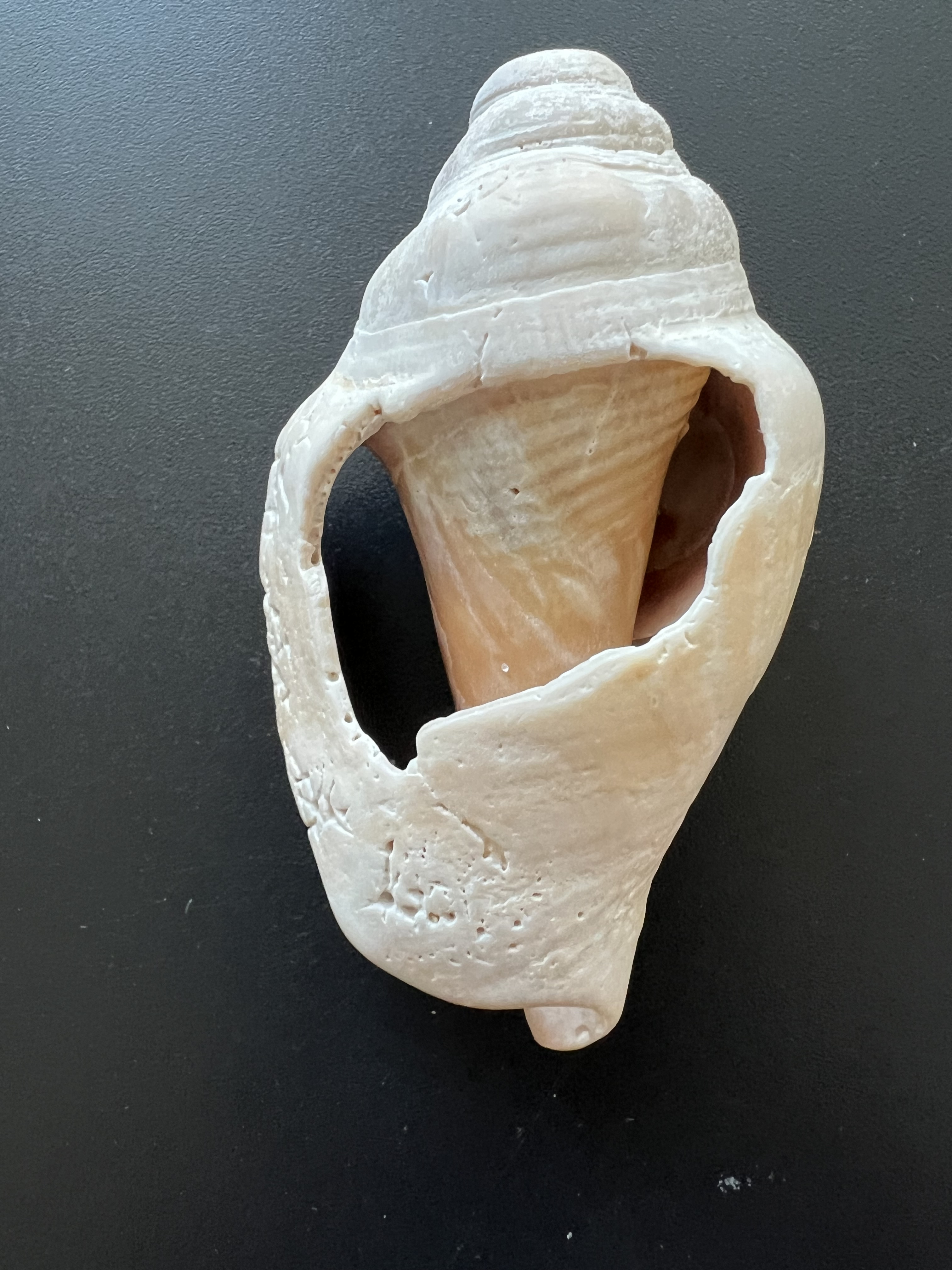
A couple of weeks ago, as I was walking on the beach, I noticed a broken shell (pictured above right) half-buried in the sand. I kept on walking, but something stopped me and I went back to look at it again. I don’t know how long I stood there studying it. I realized in those moments that even though the shell was broken, it had taken on a new kind of beauty. The damage it had suffered had transformed it into something unique.
I took the little shell home not realizing that it would not only teach me a lesson and Easter, but also about my own life.
He showed them his hands and his side
It has always fascinated me that Jesus’s wounds remained even after he was raised from the dead. Have you ever wondered about that? You might reasonably expect that he would be resurrected with a perfect, pristine body free from flaws; but no, he still bore the scars of his crucifixion.
For the first time, thanks to this little broken shell, I was able to see Jesus’s scars as a gift. Gift might seem like an odd word to describe the scars of crucifixion so let me add another odd word: vulnerable.
The word “vulnerable” comes from Latin word vulnus, which means “wound.” Think about that in terms of Jesus. His wounds are a sign of his willingness to make himself vulnerable. In fact, his entire life from beginning to end was lived in vulnerability. As St. Paul wrote to the Philippians:
Let the same mind be in you that was in Christ Jesus, who, though he was in the form of God, did not regard equality with God as something to be exploited, but emptied himself, taking the form of a slave, being born in human likeness. And being found in human form, he humbled himself and became obedient to the point of death- even death on a cross. (2:5-8)
2:5-8
Throughout history this willingness of Jesus to make himself vulnerable, to retain his scars, has been a stumbling block to belief. As St. Thomas Aquinas wrote, there were people who felt that scars and wounds implied “corruption and defect.” As reminders of weakness and vulnerability, they should not have remained after the resurrection. But they did. Jesus did not hide his scars; he embraced them; in fact, he showed them to others.
Jesus’s wounds, these reminders of weakness and vulnerability, have given us the gift of being able to embrace our own vulnerabilities, to live into our flaws and imperfections instead of trying to hide or deny them.
I don’t know about you, but I have expended a great deal of energy trying to hide my wounds and imperfections because they made me feel vulnerable. As someone on the autism spectrum, I struggled for years to be like everyone else, to hide my quirks and act like a neurotypical person. It is an exhausting way to live. But being different makes you feel vulnerable and I thought I could protect myself by being someone else. It didn’t work very well.
So, I decided to publicly embrace my autism – I even wrote a book about it. And just as I was able to see a new kind of beauty in a broken shell, I have been able to see beauty in my own life. My life is not pristine, I’m still pretty quirky. My wife Jody has her hands full trying to keep me on the straight and narrow. And as she can tell you, I’m certainly not perfect. But I am finding beauty in my imperfection.
One commentator writes that “Jesus came not to ‘fix’ us or restore us, but to make us something new. It’s through our brokenness that God’s grace can shine through. Our brokenness, in light of the wounds of Christ still visible after the resurrection…can somehow be a necessary component of the New World to come.”
They might not be visible, but we all carry scars. We have all been wounded in one way or another. Wounded perhaps by loss, chronic illness, loneliness, addiction, anxiety – the list is endless. But pretending our wounds don’t exist won’t make them go away. It is only by acknowledging them and allowing God to transform them that we find healing and wholeness.
Easter is the ultimate celebration of transformation: of death to life, grief to joy, defeat to victory, vulnerability to glory. God never promised that we wouldn’t have experiences that leave us with scars. But God does promise that it is possible to turn those scars into something beautiful.
What scars in your life need to be transformed?
Where do you need to be healed?
What prevents you from being fully, authentically yourself?
If God could transform a little broken shell into something beautiful, just imagine how much more God can do for you.
Christ is risen! Alleluia!
*This post was adapted from a sermon I gave this Easter.
Also…
The website for my book Experiencing Grace is now active.
Go to https://www.markekstrom.com/ for more information.
 Divine Overtones